Measuring What Pipes, Pumps, and Liters Can’t
Chicago-based researcher Sera Young, Ph.D., and team are advancing water insecurity understanding and action
Water security monitoring and assessment has traditionally been performed through counting pipes, pumps, and liters, generating metrics that are helpful for understanding and enhancing infrastructure. However, relying only on these metrics doesn’t address a baseline water consumption question: Do people actually have enough safe water, when they need it, for daily life?
Without information on peoples’ lived experience, governments and non-governmental organizations can overlook who is most vulnerable and why. Bringing the human voice into water data is essential to identify disparities and to hold stakeholders accountable for results, not just water supply outputs like numbers of devices installed or per capita freshwater availability.
That’s where Northwestern University’s Sera Young, Ph.D., and her team come in.
The WISE Scales: What They Do and How They’re Used
Young leads a global collaboration that developed the Water Insecurity Experiences (WISE) Scales, a rapid, cross‑culturally validated tool that measures how people experience water in everyday life.
In just 12 concise questions completed in three-five minutes, WISE Scales capture whether people had to change what they cooked, skipped washing, rationed water, or felt anxiety or shame due to unreliable water access, layering human context onto standard water supply indicators.

These items are included in the Household Water Insecurity Experience Scale 4.
Source of infographic: “Measuring human experiences to advance safe water for all,” Institute for Policy Research, Northwestern University
Crucially, WISE Scales data helps scientists, program developers, community leaders, and policymakers:
determine the magnitude of water insecurity across and within communities
track changes over time
design targeted programs
evaluate the effectiveness of interventions
“The WISE Scales turn lived experience into data,” shares Young. “Once leaders can see that these disruptions occur and who they affected, they can design smarter, fairer solutions.”
Key Achievements of the WISE Scales Network
Since first publications in 2019, and supported by the 2024 release of an open‑access guide for implementation and analysis, the WISE Scales has spread across 60+ countries and 100+ organizations.
Other notable achievements include:
Global standards and policy influence: The reliability, validity, and utility of the WISE Scales, demonstrated through peer-reviewed journals and United Nations (UN) reports, has contributed to establishment of new standards for water security measurement globally and to the enhanced ability of governments to decide on infrastructure investments.
Network and capacity building: Regional cooperation around water security has been reinforced through convenings across the Americas and Caribbean, in which academics, community leaders, policymakers, the private sector, and non-governmental organizations (NGOs) share learnings and resources.
Expanded methodologies: The Scales have catalyzed the development of other scales (e.g. scales assessing hygiene and water insecurity), showcasing the model’s replicability and value.
See how this work is unfolding, as shared with our community on social media:
Case Example: WISE Scales in Nuevo León, Mexico
As reported by the New York Times, Mexico declared a state of emergency due to extreme drought in part of the country in 2022. At the time, drinking water access was extremely limited, and water storage tanks were often inaccessible to low-income homes.
Driven in part by learnings from this crisis, Nuevo León in Mexico integrates WISE Scales into household poverty surveys. Collected data guides their drought response (bottled water distribution and hotline support needs) and poverty mitigation strategies.
In March 2025, Mexico’s National Institute of Public Health honored Young and the WISE Scales team with the inaugural Champions of Health Award for humanitarian impact.
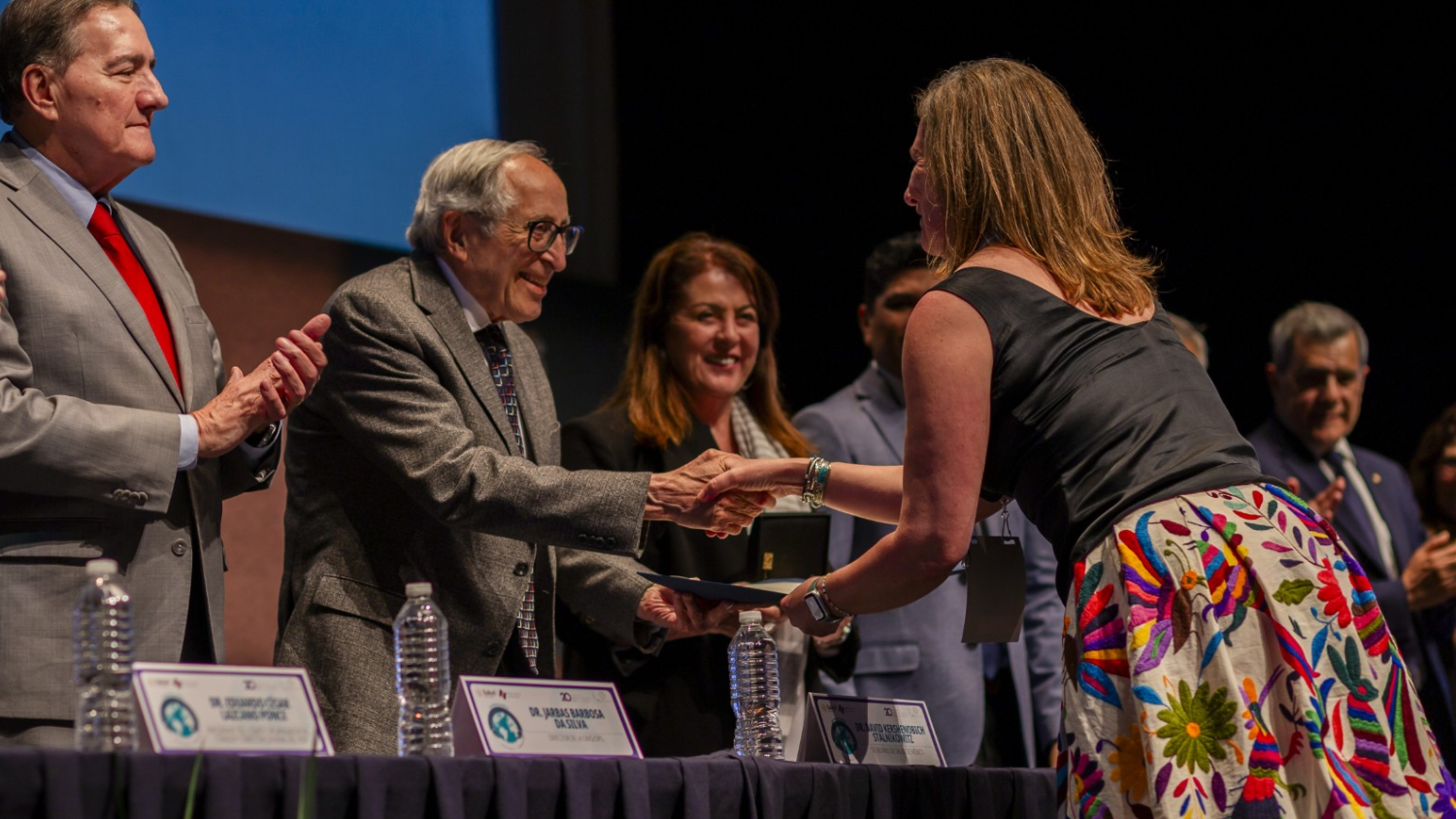

“The inclusion of WISE into Nuevo León’s poverty surveys aids response on the ground and who gets help in times of crisis,” shares Young. “Water insecurity has now become a part of the definition of need. That’s the power of experience‑based data.”
Seed Investments, Outsized Impact
When Elizabeth Walder learned of Young’s water insecurity work, she saw a chance to offer financial and relational support to Young to help maximize reach and impact. Young’s team has since advanced WISE-related efforts — bridging research and practice, building implementation resources, and sharing results in ways that decision‑makers can use.
Under Young’s leadership, WISE Scales has moved from an academic insight to a policy tool recognized by ministries of health, development agencies, and UN platforms — a testament to Walder Foundation’s philosophy that targeted, early‑stage funding can unlock systemic change.
“Elizabeth’s belief gave us momentum,” Young said. “A modest investment helped us to build a global tool that’s changing how and who we serve.”

Sera Young (left) and Elizabeth Walder (right) at Walder Foundation in November 2025
What’s Next: Expanding the Reach and Influence of WISE Scales
Young looks forward to 2026 and beyond, outlining opportunities for greater dissemination and impact including:
Training and capacity: Ongoing interactive, multilingual trainings hosted will help governments and NGOs implement the Scales quickly and consistently
Regional networks: Building WISE Scales communities in Africa and the Middle East to foster peer learning and government‑led rollouts
Government adoption: Following Mexico’s lead, Brazil, Malawi, and Kenya are exploring or initiating national use, showing how experience‑based metrics can scale across contexts
Global stage: The UN Water Conference (December 2026) is a key milestone to embed lived‑experience measures into policy frameworks beyond 2030
“Our goal is simple: make water insecurity visible everywhere,” shares Young. “When people’s experiences are quantified, they’re harder to ignore. We see this again and again, from Australia to Brazil to Kenya to the United States.”
Get more stories like this delivered to your inbox.
Sign up with your email address to receive news and updates.