When Dreamers Rise, Our Cities Rise
New data highlights the impact of Dreamers in Illinois
For decades, children who were raised in the United States without legal immigration status or citizenship have been waiting for a solution to their unique circumstances. As the decades pass, these children — often referred to as Dreamers — become adults with U.S. school system education and fluency in English, and they often only know the States as their home. Yet, without access to a process to obtain permanent legal status or citizenship, this population lives in limbo of what the future holds.
Dreamers face tremendous obstacles, but they have also been among the most motivated students in the country.
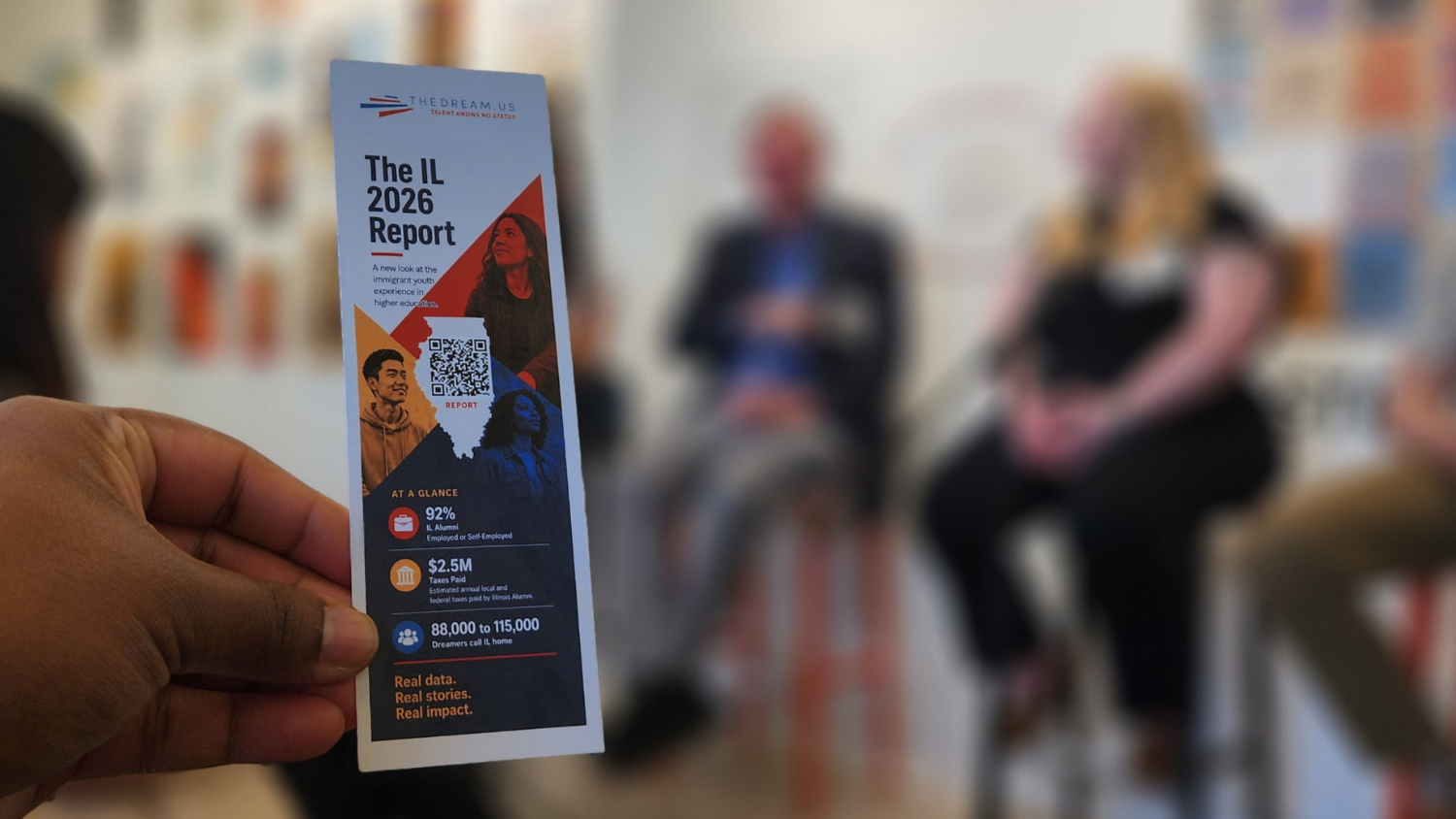
A new report by TheDream.US, When Dreamers Rise, Our Cities Rise, tells the data and stories behind the impact of investing in Dreamers’ education in Chicago and Illinois. With support from donors, including Walder Foundation and Schreiber Philanthropy, TheDream.US has distilled the significance of this national conversation to a local context.
About TheDream.US
Founded in 2013, TheDream.US was created to address fundamental barriers for Dreamers: they’re ineligible for federal financial aid and loans, often have limited access to state aid, and sometimes face paying for expensive out-of-state tuition. These barriers place higher education out of reach for many talented students.
What began as a conversation between a few civic and business leaders in 2013 quickly became a national effort to expand access to college for Dreamers, supported by partnerships with nearly 80 colleges across the country. Over the past decade, TheDream.US has awarded 12,000 scholarships (900+ in Chicago and the greater region) to immigrant youth for higher education-related costs like tuition, fees, on-campus housing, and meals. Those supported come from over 120 countries and 45 states, with more than 4,500 (370+ in Illinois) college graduates to date.
The organization continues to center access to higher education as a critical pathway to long-term stability and opportunity. Their work sits at the intersection of education, economic mobility, and systems change.
Who Are the Dreamers Today?
For many, the term “Dreamer” evokes images of young students. However, public perception often lags behind reality.
“While the public often imagines Dreamers as teenagers, the reality is that many are now adults building careers, raising families, and contributing significantly to their communities and the economy,” shares Gaby Pacheco, president and CEO of TheDream.US.
Across the U.S., about 2.6 million Dreamers entered the country at age 18 or younger. In Illinois alone, an estimated 88,000 to 115,000 Dreamers, including roughly 28,000 Deferred Action for Childhood Arrivals (DACA) recipients — who have temporary legal protections allowing them to live and work in the U.S. — are part of local communities as professionals, entrepreneurs, parents, and civic leaders. Many are actively shaping the state’s workforce and economy.
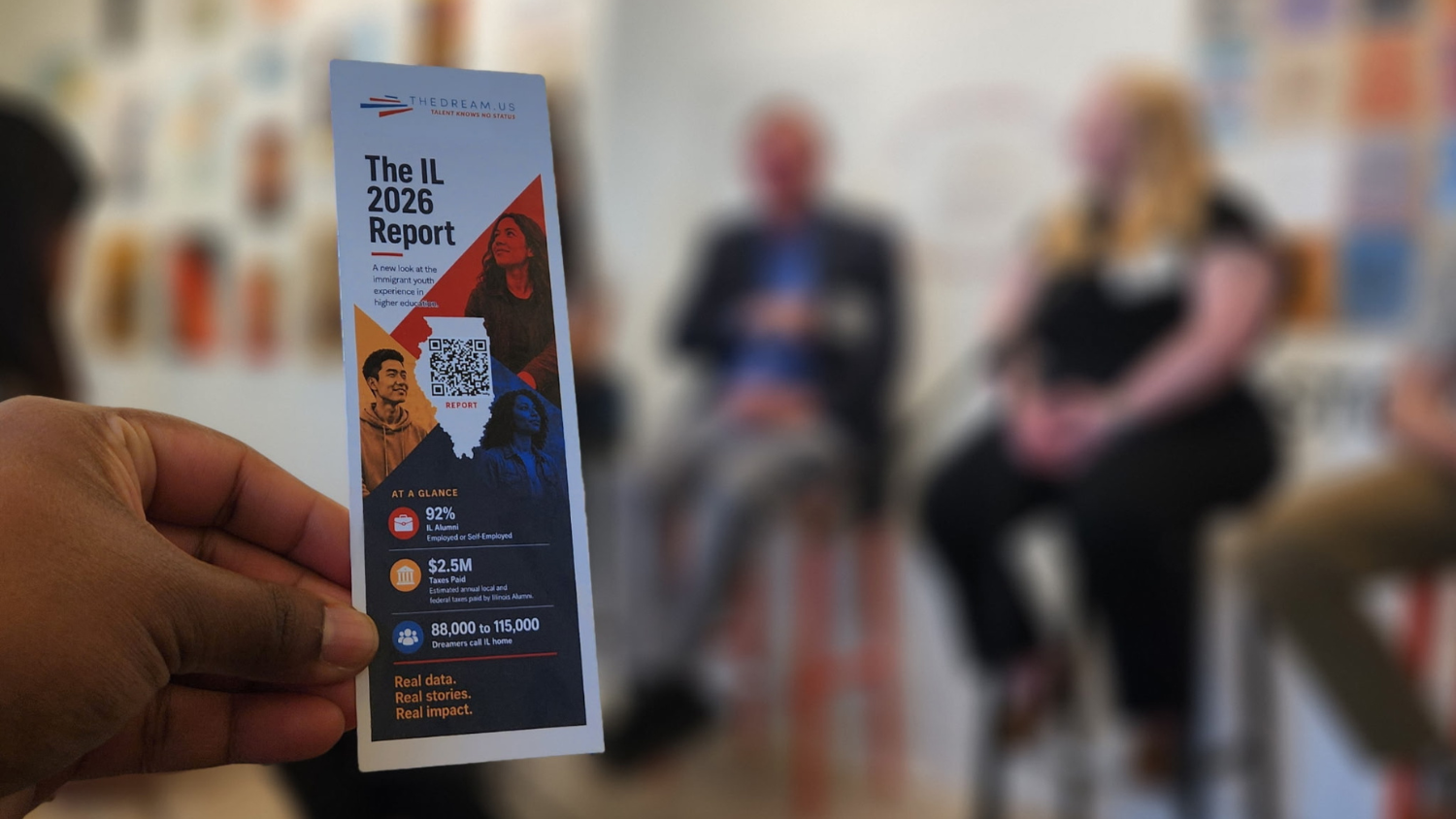
Illinois scholar data, as shared in When Dreamers Rise, Our Cities Rise, outlines that 85% of college-enrolled Dreamers are the first in their family to attend college. Of the TheDream.US alumni in Illinois, 78% have work authorization and 92% are employed or self-employed.
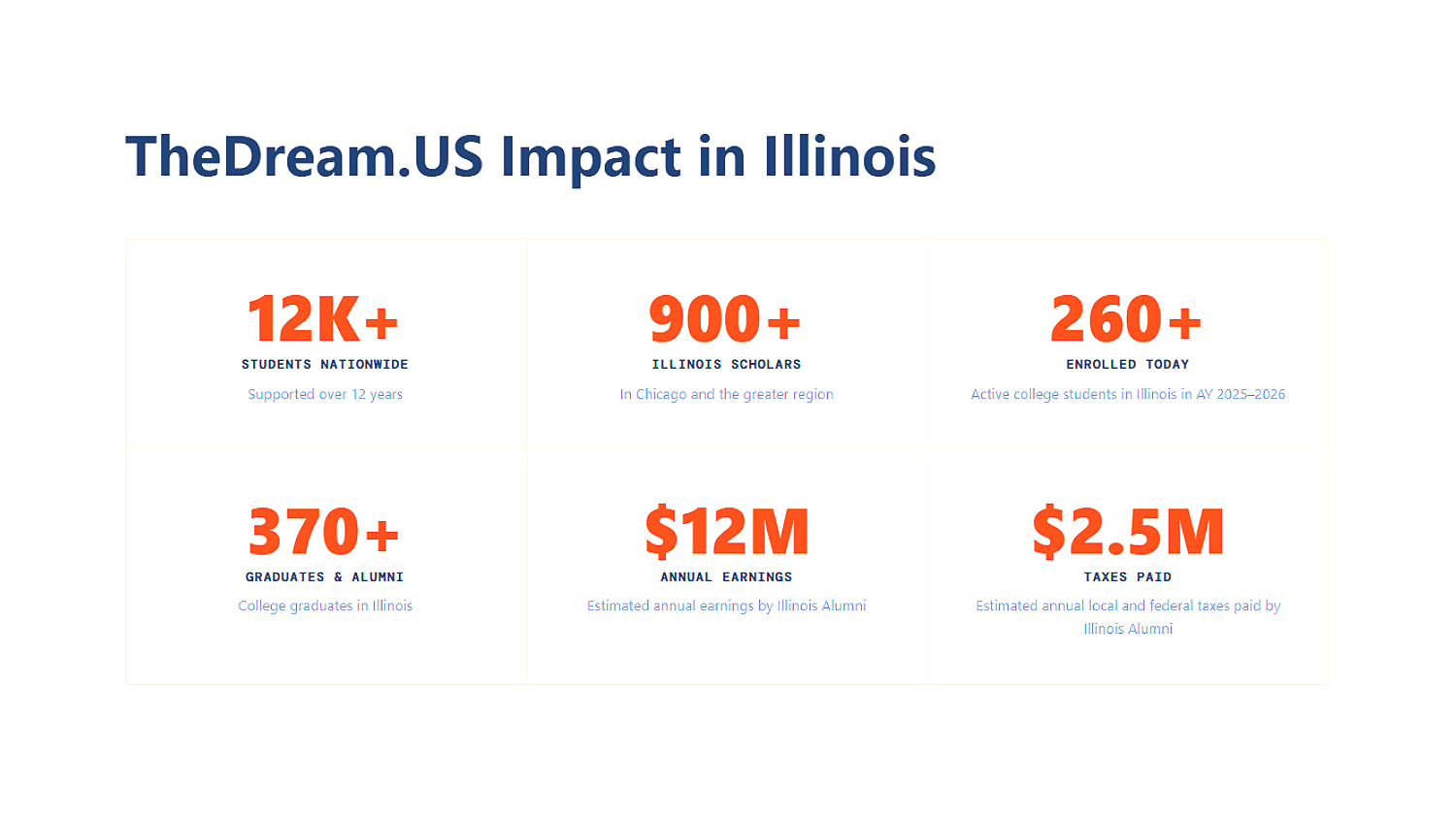
An infographic from When Dreamers Rise, Our Cities Rise, a report of TheDream.US.
Chicago and Illinois in Focus
Dreamers in Chicago and Illinois generally have greater access to opportunities than in many other states.
“Illinois provides Dreamers in-state tuition and access to state financial aid, policies that make higher education more attainable,” shares Pacheco. “They may also obtain driver’s licenses, which increases mobility and access to work, school, and community life.”
Pacheco sees such policies and opportunities as “investments that generate long-term returns through higher earnings, greater tax contributions, increased entrepreneurship, and stronger local economies.”
When Dreamers Rise, Our Cities Rise showcases TheDream.US alumni from Illinois have estimated annual earnings totaling over $12 million and pay over an estimated $2.5 million annually in local and federal taxes.
Nevertheless, Pacheco notes that Illinois-based Dreamers continue to face significant barriers.
“Chicago has some of the highest college tuition costs in the country, placing enormous financial pressure on immigrant families,” shares Pacheco. “While community colleges serve many Dreamers, students often face structural barriers that make it more difficult to complete degrees on time, including the need to work while studying, limited advising, support, and ongoing uncertainty around immigration status.”
Challenges are also persistent for Dreamers who were able to obtain DACA. DACA is only a temporary administrative policy, not permanent law. It does not provide a pathway to citizenship or long-term legal status and is continuously vulnerable to policy and workforce changes. Therefore, existing DACA recipients live under constant uncertainty about the program’s future.
See how this work is unfolding, as shared with our community on social media:
Integration as Economic Infrastructure
The public narrative on investing in Dreamers needs to be reframed from a risk to an investment.
“When we say that ‘integration is not charity, it is economic infrastructure,’ we mean that investing in immigrants and Dreamers is not simply an act of compassion — it is essential to the long-term economic health and competitiveness of cities like Chicago,” Pacheco said.
Dreamers are already embedded in the fabric of civic and economic life, working in industries including healthcare, education, business, and technology. Many help fill critical labor shortages.
“Dreamers are often bilingual, highly educated, and uniquely positioned to contribute to communities and markets,” she said.
The report showcases stories of individuals who are persevering despite obstacles, including a young woman from Poland who arrived at the age of seven and is now pursuing her dream of becoming an attorney and a young man who navigated financial hardships to become an accountant.
These Dreamer examples are not exceptions. They are real people representing a broad range of experiences, dreams, talents, and contributions.
From Insight to Action
During a recent fireside conversation held in Chicago, civic, business, and philanthropic leaders gathered to discuss expanding access to higher education and career pathways, strengthening cross-sector collaboration, and identifying opportunities for philanthropy and policy to align. Set against the backdrop of the growing urgency to develop a long-term policy solution for Dreamers in the U.S., the event offered both a moment of reflection and a call to action.

Gaby Pacheco (far right with microphone) speaks alongside other panelists during a June 2026 fireside conversation.
The next step is to share available data broadly and widely. How Dreamers are understood and whose stories are heard could enable greater understanding and perhaps result in long overdue solutions for individuals waiting for a clearer path forward.
“Too often, Dreamers are discussed only in political terms, while their humanity, contributions, and lived experiences are overlooked,” Pacheco said. “By elevating their stories, we want people to better understand that Dreamers are our classmates, coworkers, neighbors, parents, educators, and leaders. They have grown up in our communities and are deeply invested in the future of this country.”
Future economic growth and strengthened communities are other favorable outcomes related to Dreamer investments. Sharing this type of data helps, too.
“Dreamers have already contributed enormously to our cities, communities, and economy,” Pacheco said. “Providing them with stability and opportunity is not only the right thing to do, but it will also make our country stronger and more prosperous for everyone.”
Stay engaged with Walder Foundation’s Migration and Immigrant Communities program area: walderfoundation.org/migration-and-immigrant-communities
Get more stories like this delivered to your inbox.
Sign up with your email address to receive news and updates.