Engineering Biological Solutions for Societal Impact
Request for Proposals
Walder Foundation invites applications for early-stage research projects that leverage synthetic biology to engineer solutions to challenges that affect people and the systems on which they rely. This includes advances that improve human health and well-being, strengthen environmental and agricultural systems, enable new approaches to materials and manufacturing, or otherwise expand the capacity of engineered biology to deliver public benefit.
We welcome both applied research and foundational, tool-building, or platform technologies, provided the work plausibly advances the design, construction, and responsible application of biological systems with relevance beyond the laboratory. Proposals are not required to demonstrate immediate translation, commercialization, or deployment, but should articulate a clear pathway by which the research could ultimately contribute to positive outcomes for society.
Key Dates
February 10, 2026: Request for Proposals open
March 10, 2026: Informational webinar hosted by Walder Foundation. Register below!
April 15, 2026: Letter of Intent (LOI) due by 5 p.m. CT; Please note: Walder Foundation offices will be closed April 1-9, 2026. Interested applicants are highly encouraged to start their applications in our grant management system (akoyaGo) before or by March 26 to ensure timely Foundation staff support and adequate access to the grant submission system.
May 2026: Competitive applications invited for full proposal
Summer 2026: Proposals due
Fall 2026: Earliest notification of decisions
Winter 2026: Expected award start date
INFORMATIONAL WEBINAR
Mar 10, 2026 12-1 p.m. CT
During this webinar, Walder Foundation staff provided an overview of the funding opportunity, outlined eligibility and application requirements, walked through the timeline, and answered questions from prospective applicants.
OPPORTUNITY
Overview
Synthetic biology is redefining what is possible at the intersection of engineering and life sciences, offering unprecedented tools to design, build and optimize biological systems with precision. By enabling breakthroughs that range from programmable therapeutics and engineered cells to resilient crops and renewable resources, this versatile discipline has the potential to develop transformative solutions for the future of human health and wellbeing.
Chicago is uniquely positioned to lead the next era of synthetic biology innovation. As a city defined by its problem-solving ethos, industrial ingenuity, and collaborative scientific community, this burgeoning biotech hub brings together the strengths needed to turn foundational research into real-world impact.
Through this initiative, Walder Foundation aims to catalyze transformative advances in synthetic biology by empowering pioneering researchers whose work expands what is possible in the design, construction, and responsible application of engineered biology for social benefit.
Awards of up to $400,000 USD total costs over two years (24 months) will be awarded to eligible Illinois research institutions as grants to support the execution of the proposed project.
Program Objectives
Walder Foundation invites applications proposing innovative strategies that implement synthetic biology to develop solutions to an array of challenges with broad social impact.
Through these grants, we hope to:
Advance research that leverages biological engineering to improve human health and wellbeing
Accelerate high-risk, high-reward research that challenges conventional approaches
Empower innovators to pursue new research directions to engineer novel bio-based systems
Support early-stage applied research to develop novel solutions-focused technologies
Promote ethical, equitable, and sustainable innovation, ensuring the benefits are shared broadly
Catalyze scalable real-world biotech solutions with the potential to tangibly improve human wellbeing
Bolster the Greater Chicago synthetic biology research community and develop technologies with the potential to fuel regional bioeconomic growth.
Project Guidance
The award supports the development of biologically engineered solutions to advance human health, environmental resilience, sustainable agriculture, and renewable resources. Competitive applications will explicitly address challenges within these areas and may include, but are not limited to, applications such as diagnostics or biosensors, therapeutic development or delivery, disease prevention or surveillance, microbiome engineering, responsive or regenerative medicine, bioremediation, enhanced agriculture, or waste valorization.
We seek proposals that exemplify creativity, rigor, and the potential to translate synthetic biology into novel, scalable solutions with potential for real-world impact. The program prioritizes early-stage development or application of novel technologies. Proposals should have compelling rationale but not necessarily robust supporting data.
Responsive projects may:
Expand the synthetic biology toolkit or develop new modular genetic circuits
Accelerate discovery through computational analysis for prioritization and biological insights
Significantly enhance robustness, reliability, predictability, and tuneability of current designs
Support early validation of novel molecular components
Leverage microbial, cellular, or plant-based systems
Projects that will not be considered may:
Lack connection to molecular biology and engineering
Focus solely on incremental characterization of well-known pathways without novel elements
Lack clear translational potential for real-world impact
Present insubstantial iteration on existing systems
Focus solely on clinical applications or therapeutic trials without innovative technology development
Propose computational design without biological validation
Propose large-scale screens or resource generation without development of engineered solutions
Propose industrial-scale process or materials development
Projects under consideration will be prioritized based on:
The novelty and ingenuity of the proposed approach
The opportunity gap for the problem being addressed
The potential impact, practicality, scalability and utility of the technology or application developed
The relevance of the technologies and approach to key areas of programmatic interest
Project maturity, with earlier stage, higher risk/reward projects prioritized for funding
The ethical and societal responsibility of the technology
Application Process
Stage 1: Letter of Intent (LOI) will be reviewed for eligibility and alignment with program objectives. Competitive concepts will be invited to submit a full proposal.
Stage 2: Invited Proposals will be evaluated for scientific merit through independent expert review. Feedback received from expert reviewers is used by the Foundation to make funding decisions. When selecting the final cohort of awardees, other factors considered may include alignment with Foundation goals and award program objectives, the breadth of topics addressed, and the types of approaches employed.
APPLICATION GUIDE
This guide contains instructions to complete an application for the 2026 grant cycle, including document formatting and proposal guidelines. Please review the entire guide before beginning the application process.
-
This award aims to advance the most compelling and competitive solutions, regardless of the source. All tenure track faculty holding appointments at the Illinois research institutions specified below at the time of application submission are eligible. Walder Foundation encourages applications from organizations with a demonstrated commitment to fostering equitable opportunities, accessibility, and inclusion in STEM and the biological and environmental sciences, including by creating opportunities for researchers who have faced barriers to career advancement. Proposals will be evaluated based on the potential for future impact and not solely on the applicant’s prior accomplishments.
Applications may be submitted by academic, nonprofit, or government research institutions located in Illinois that are governmental unit or registered Section 501(c)(3) organizations classified as 509(a)(1) or 509(a)(2) public charities, or are working with a fiscal sponsor that meets this requirement.
Grants will be awarded to the primary institution affiliated with the lead investigator, not the individual, and this institution will be responsible for distributing sub-award funds to eligible collaborating institutions, where applicable.
There is no limit to the number of applications submitted by an institution. However, an individual can only serve as lead investigator on one application.
Further information for collaborative submissions:
The lead investigator is the faculty member initiating the project who will be responsible for proposal submission and reporting. Collaborators identified as co-investigators may be tenure or research track faculty appointed at any eligible institution. An individual may serve as lead investigator for one LOI submission and may serve as co-investigator for no more than two LOI submissions. When submitting multiple proposals with overlapping teams, proposals must be scientifically or technologically distinct. A project-specific letter of support from each co-investigator is required for collaborative projects. The home institution of the lead investigator is responsible for administering any necessary sub awards for inter-institutional collaborations.
-
Due: April 15, 2026 by 5 p.m. CT
Please note: Walder Foundation offices will be closed April 1-9, 2026. Interested applicants are highly encouraged to start their applications in our grant management system (akoyaGo) before or by March 26 to ensure timely Foundation staff support and adequate access to the grant submission system.
To complete the LOI submission, applicants will fill a brief online form through Walder Foundation’s grants management system, akoyaGO. Detailed instructions are included below. To create an account, you will need your organization’s EIN. Please work with your organization’s sponsored research or development department on the online application.
Applicants will provide a brief overview of their project in an online form and should aim to address each of the following aspects with responses of 1-2 paragraphs.
Provide a plain-language executive summary of the request
Describe the societal challenge addressed within the program’s focal areas
Describe the scientific approach of this project and its novelty
Identify the potential impacts of this research and how it could contribute to positive outcomes for society.
Outline how the funds will be used to support this project
Identify up to five technical keywords that best reflect the proposed research
LOIs will be reviewed for eligibility and alignment with the program objectives. Applicants with competitive concepts will be invited to submit a full proposal in April 2026.
-
Upon invitation, applicants will receive instructions and guidance for uploading complete documents to their existing akoyaGO accounts. Information requested will include:
Cover Page
Descriptive project title that conveys both the scientific challenge and the innovative approach
Lead investigator name(s), affiliations, and contact information
Abstract (300-word limit) Plain-language summary of the project and potential impact
Narrative (six-page limit, excluding citations)
Background & Significance
Describe the background and previous work that has led to this project and its context within the current literature and state of the art. Identify the knowledge or technology gap your research fills and how the project advances synthetic biology beyond the current frontiers.
Clearly define the problem your project aims to address and articulate how success may advance human health and wellbeing.
Research Objectives & Methods
Articulate the specific goals of the project and specify any hypotheses that will be tested.
Describe the methods, experimental design and analytical frameworks.
Briefly justify the chosen models, materials and systems.
Discuss potential project risks and proposed mitigation strategies.
Timeline & Anticipated Outcomes
Identify research outcomes anticipated within the award period.
Briefly describe the next steps for this project, if outcomes are as anticipated, toward translating or disseminating the research for real-world impact.
Data & Materials Management Plan
Briefly outline how data and materials generated in this project will be made accessible to the research community.
Social, Ethical, & Safety Considerations
Briefly discuss social, ethical, or biosafety considerations of this project and their management.
Budget (template provided) including categorized line items of anticipated expenses for each project year.
Total budget of $400,000 over two years, including up to 15% indirect costs.
Budget Narrative
Provide a high-level summary of each expense category and any significant line items.
Outline the roles and any exceptional qualifications of budgeted personnel.
Biographical Sketch
Detail the professional history, research contributions, and career objectives of the lead investigator.
Current & Pending Support
Provide brief information on all current and pending funding for ongoing projects and proposals, including the project title, source and status of support, award period, and total award amount
Letters of Support
Recommended for all applications but required for collaborative or cross-institutional projects and those for which other parties are partnering or contributing significant materials or services.
-
All uploaded documents must follow the formatting guidelines. Documents must be saved in Word doc or PDF formats.
Documents should be formatted as follows:
Arial, Calibri, or Times New Roman font of size 11-point or larger.
At least 0.5” margins on all sides.
Single line spacing and standard character spacing (neither expanded nor condensed).
Documents should be 25 MB or less and may not be password protected.
For any Excel documents you upload, please be sure to format so that all columns are visible on one page when printing or converting to pdf.
Documents that do not adhere to these restrictions may not be reviewed.
For questions about award eligibility or the application process, please contact us in advance of the proposal deadline at science@walderfoundation.org.
HOW TO APPLY
You will need to create an account in akoyaGO, Walder Foundation’s grants management system. To create an account, you will need your organization’s Employee Identification Number (EIN). If you already have an account, proceed to “Begin your Letter of Intent (LOI) application” below.
Please note: Walder Foundation offices will be closed April 1-9, 2026. Interested applicants are highly encouraged to start their applications in our grant management system (akoyaGo) before or by March 26 to ensure timely Foundation staff support and adequate access to the grant submission system.
Click on the link below to access the grantee portal:
Walder Foundation Grantee Portal
If the link is not working, please copy/paste this text into your preferred web browser: “https://goapply2.akoyago.com/walderfoundation/Identity/Account/Login?ReturnUrl=%2Fwalderfoundation%2Fapplication%2F2026SCIAward"
Choose “Or create a new account” (or sign in if you already have an account):

2. Select “Organization”

3. Choose your region – “United States” or “Canada” – and search for your organization using the Tax ID number. If your organization is outside of the United States or Canada, click on the link that says “Skip, manually enter” and input your organization’s information.

4. You will see a list of organizations matching that Tax ID number. It is possible that you see more than one entry for your organization, and it may have a staff member’s name following the organization name, for example, “Walder Foundation – Monica Chavez”. Click “Select” next to the entry for your organization that does not have a staff person’s name next to it.
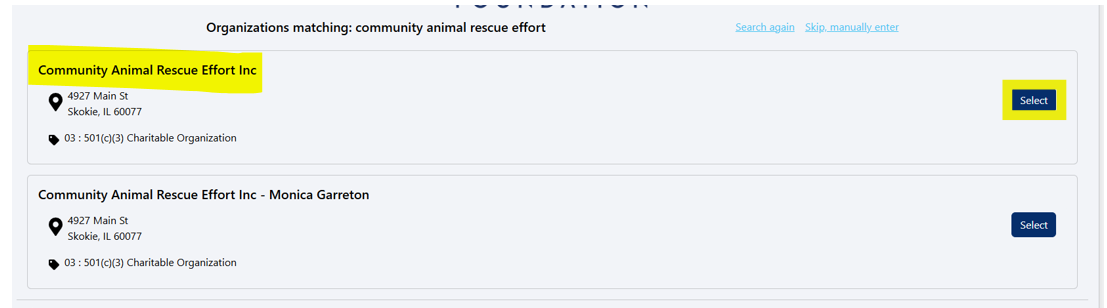
5. If your organization is new to our database and does not show up on the list, choose the “Skip, manually enter” option.
6. A screen will appear with fields you may fill out to create your new account.
7. Once you have completed the registration form and submitted it, your registration request will be reviewed. You will receive an email confirmation after it has been accepted, and you are free to access the grant portal. Please note that the process is typically quick but may take up to two business days.
Begin your Letter of Intent (LOI) application
Once your user account has been accepted, use the link below to login and begin working on your application:
Walder Foundation LOI Form
If the link is not working, please copy/paste this text you’re your preferred web browser: “https://goapply2.akoyago.com/walderfoundation/Identity/Account/Login?ReturnUrl=%2Fwalderfoundation%2Fapplication%2F2026SCIAward”
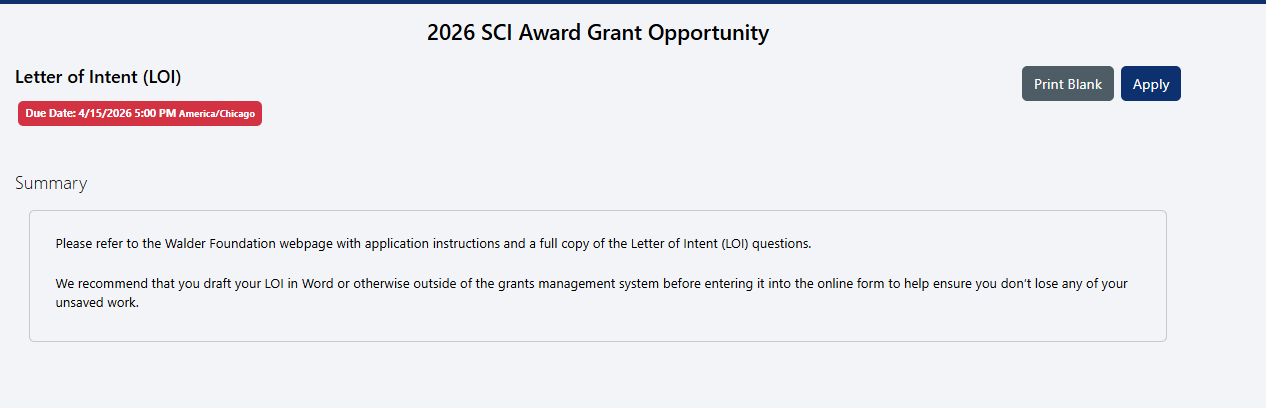
You will be able to log in anytime (up until the deadline) to work on your application and save your progress. We recommend creating your account early to familiarize yourself with the system and the application form.
An automated email confirmation is generated upon submission of the LOI. If you do not receive a confirmation within 24 hours of submitting your LOI, please check your spam folder and then contact: grants@walderfoundation.org.
CONTACT INFORMATION
For inquiries about the content of your application, send an email to the program team member who shared this webpage with you, or science@walderfoundation.org.
For inquiries about the grants management system, send an email to grants@walderfoundation.org.