Defining Welcome
A funding opportunity to explore and strengthen a welcoming Chicago region
OVERVIEW
Walder Foundation is inviting proposals for one- to two-year projects that continue to inform the public narrative on migration in the Chicago metropolitan area. The Foundation intends to award up to $1,000,000 in grants for local journalism, bridge-building initiatives, trainings and workshops, and/or research that helps define, explore, and strengthen the narratives that shape a welcoming region.
-
The Chicago region has long been a gateway for immigrants and refugees from around the world. Even as immigration emerges as one of the most divisive issues of our time, the Chicago region has maintained its commitment to advancing a culture of welcome and navigating complex challenges. Throughout the metropolitan area, residents, leaders, and a range of institutions are creating inclusive spaces, fostering belonging, and addressing tensions to build thriving communities for all. They value how our region’s social, economic, and cultural fabric is enriched when we facilitate and uplift the contributions of various populations.
Building welcoming and inclusive communities requires long-term intentional strategies, collaborations, commitments, and investments by a range of stakeholders. Civil society, faith-based communities, schools, universities, cultural institutions, local governments, and the private sector, among others, are all positioned to build bridges across lines of difference, integrate intersectional approaches, and harness the benefits of a welcoming ecosystem. Meanwhile, local media has the platform to inform broad audiences with stories, evidence, and data that shape public understanding of the impacts and opportunities of being a welcoming region.
Through this request for proposals, Walder Foundation seeks to support projects and initiatives that examine the local approaches and impacts of welcoming frameworks. How is welcoming work showing up in different communities and sectors? What challenges are communities facing, and how are they overcoming them? In what ways have welcoming initiatives improved the social, cultural, and economic fabric of the region? The Foundation is particularly interested in projects that engage new audiences, build bridges across lines of division, and expand programs that have demonstrated potential for greater impact. Proposals should uplift the experiences of being a welcoming region, identify solutions to complex migration challenges, and/or define approaches to welcoming that can help all communities in the Chicago region thrive.
-
This opportunity is by invitation only. One- and two-year grants between $25,000 and $100,000 will be awarded to nonprofit organizations that propose initiatives to strengthen the public narrative about migration in the Chicago metropolitan region. A total of up to $1,000,000 in grants will be awarded in 2026.
Grants will be awarded based on a variety of criteria, including the ability to engage either hard-to-reach communities or public audiences at scale, to provide innovative approaches and new data analyses, to fill gaps in the current narrative landscape, and to contribute meaningful impact. Funding will be prioritized for organizations that have a positive track record in informing public dialogue and navigating highly complex and sensitive issues. The amount of the grant will be determined by the proposed budget as well as the size of the project relative to the organization’s operating budget.
Collaborations and partnerships are highly encouraged, and letters of support or a Memorandum of Agreement are requested.
Please know that as Walder Foundation strategies and grant initiatives continue to evolve, this RFP is a one-time opportunity. Applicants should not have any expectations that awarded grants will be renewed beyond the scope of this RFP. Please keep this in mind when planning for the sustainability of this work.
-
Nonprofit journalism that helps the public better understand how Chicago’s leadership, institutions, and residents are responding to the rapidly evolving immigration landscape. Projects may explore how organizations are overcoming challenges amidst frequent policy changes, the impact of shifting migration patterns, the lived experiences of immigrant communities as they navigate life in Chicago, how residents are supporting immigrant neighbors, and the contributions of immigrant and refugee communities to the region.
Bridge-building initiatives that meaningfully engage communities across lines of difference on immigration to address tensions, strengthen relationships, and promote a shared sense of community. Projects may engage interfaith leaders, the business community, suburban areas, educational institutions, and other stakeholders to promote understanding across political and ideological divides, build trust, and deconstruct and address misinformation.
Trainings, workshops, and convenings that develop trauma-informed practitioners, leaders, and storytellers in the Chicago region to strengthen more welcoming organizations, systems, and communities. Projects that highlight resilience, dignity, and cultural richness while promoting mental wellness and community leadership are encouraged.
Research that provides up-to-date quantitative and qualitative data on the impact of immigration in Chicago. Data can serve as evidence to identify priorities for creating and expanding welcoming programs and infrastructure that harness the benefits and mitigate the challenges of being a welcoming region.
-
Applicants must be a registered Section 501(c)(3) organization classified as a Section 509(a)(1) or 509(a)(2) public charity, or a project within a fiscal sponsor organization that meets this requirement.
Applicants must have a mission that prioritizes uplifting immigrant, refugee, and asylum-seeker communities.
Applicants must be either located in the greater Chicago metropolitan region (Cook, DuPage, Kane, Kendall, Lake, McHenry, or Will counties) or whose work will be centered in communities of the Chicago metropolitan area.
Proposals will not be considered if they are intended to influence legislation, to influence the outcome of any election for public office, to carry on any voter registration drive, or to undertake any activity for a purpose other than charitable, scientific, educational, or other purposes specified in Section 170(c)(2)(B) of the Internal Revenue Code.
-
Alignment: Does the proposal help the public access higher quality journalism, community dialogues, and research that provides a more nuanced understanding of the complexity of immigration issues Chicago faces?
Impact: Does the proposal aim to help define and advance programs for a welcoming Chicago metropolitan region?
Leadership: Does the team leading the work in the proposal have a positive track record of experience working in this field?
Unique Contribution: Is the organization uniquely positioned to help contribute to a stronger ecosystem, either through its expertise in the field, the stakeholders it engages, or the geography in which it is located?
Creativity: Will the project provide new or expanded analysis, recommendations, data, or approaches to inform public narratives?
Reach: Will the project reach the public-at-large or engage new audiences, with a particular emphasis on hard-to-reach communities?
Collaboration: Does the organization have a history of partnerships and experience to build a strong ecosystem across the metropolitan area?
Feasibility: Is the proposal feasible with the resources, time, and capacity needed?
Risk: Have consequences, including potential unintended consequences, been considered to mitigate any possible harm?
-
Applications Invited: June 2026
Proposal Deadline: July 27, 2026, at 5 p.m. CT
Notifications: October 2026
Grant Period Begins: October 2026
Application Process
You will need to create an account in akoyaGO, Walder Foundation’s grants management system. To create an account, you will need your organization’s Employee Identification Number (EIN). If you already have an account, proceed to “Begin your application” below.
Click on the link below to access the grantee portal:
Walder Foundation Grantee Portal
If the link is not working, please copy/paste this text into your preferred web browser: “https://goapply2.akoyago.com/walderfoundation/application/2026MICNarrativeCycle” into your preferred web browser.
Choose “Or create a new account” (or sign in if you already have an account):

3. Select “Organization”
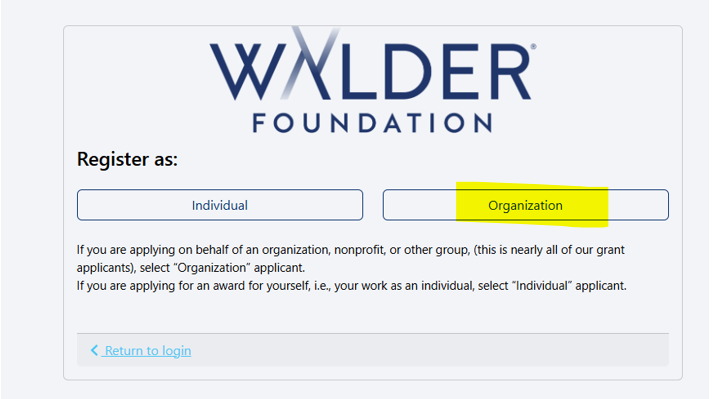
4. Choose your region – “United States” or “Canada” – and search for your organization using the Tax ID number. If your organization is outside of the United States or Canada, click on the link that says “Skip, manually enter” and input your organization’s information.

5. You will see a list of organizations matching that Tax ID number. It is possible that you see more than one entry for your organization, and it may have a staff member’s name following the organization name; for example, “Walder Foundation – Monica Chavez”. Click “Select” next to the entry for your organization that does not have a staff person’s name next to it.
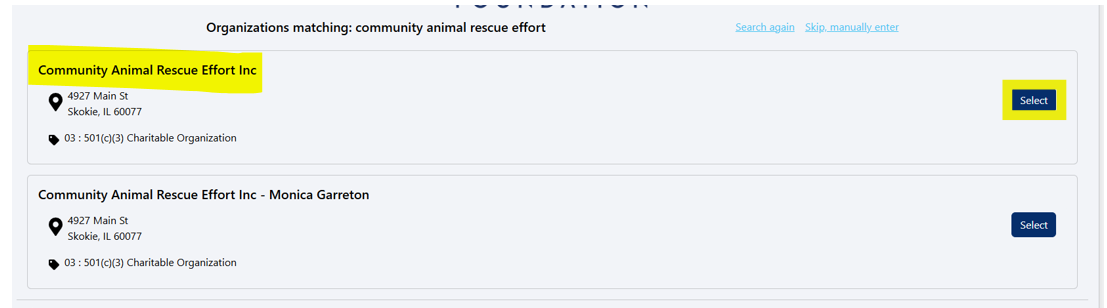
5. If your organization is new to our database and does not show up on the list, choose the “Skip, manually enter” option.
6. A screen will appear with fields you may fill out to create your new account.
7. Once you have completed the registration form and submitted it, your registration request will be reviewed. You will receive an email confirmation after it has been accepted, and you are free to access the grant portal. Please note that the process is typically completed quickly but may take up to two business days.
Begin your application
Once your user account has been accepted, use the link below to login and begin working on your application:
2026 Narrative Cycle Application Form
If the link is not working, please copy/paste this text you’re your preferred web browser: “https://goapply2.akoyago.com/walderfoundation/application/2026MICNarrativeCycle”
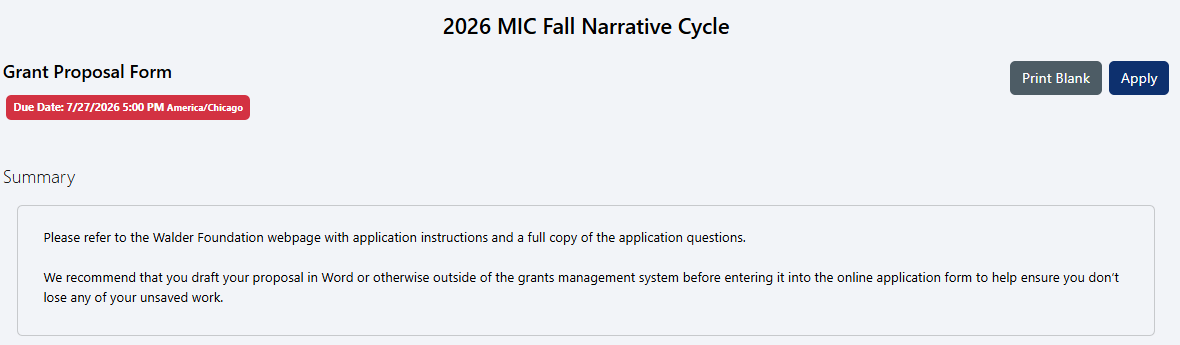
You will be able to log in anytime (up until the deadline) to work on your application and save your progress. We recommend creating your account early to familiarize yourself with the system and the application form.
>> VIEW A SAMPLE PROPOSAL FORM FOR COMPLETE REQUIREMENTS
An automated email confirmation is generated upon submission of the application. If you do not receive a confirmation within 24 hours of submitting your application, please check your spam folder and then contact grants@walderfoundation.org.
Applications must be submitted by 5 p.m. CT on July 27, 2026.
CONTACT INFORMATION
For inquiries about the content of your application, send an email to immigration@walderfoundation.org.
For inquiries about the grants management system, send an email to grants@walderfoundation.org.